
.webp)


Photo: [caption goes here]
Your child may not be sick. They may even appear perfectly healthy. But sometimes, as a parent, you can sense that something just isn't quite right.
Learning delays. Problems with focus or emotional regulation. Challenges that seem to have no obvious answer.
And for parents, that can be incredibly frustrating.
You know your child is capable of more, but you may not know what is getting in the way.
At Brookvale's Brainshape and Freshwater Chiropractic, that question is where the work starts.
The integrated practice works with families across a range of developmental, behavioural and physical challenges, looking at how the brain and body are developing and communicating with each other.
"We work with families: mums and dads with children," says Dr Zoe Braund, founder and co-owner of Brainshape.
"The majority of our clients are kids experiencing challenges with either a learning delay, emotional regulation, focus or attention problems, movement coordination or muscle tone, or task avoidance; and then from the chiropractic side, mums that just aren't coping or are overwhelmed."
With more than 25 years in the field, Dr Zoe has worked across all ages, but it is children, particularly those experiencing developmental challenges, where she says she feels most at home.

For some families, the first instinct may be to look for a diagnosis or medication.
While medication can have an important role in managing some neurodevelopmental conditions, side effects and individual responses can make finding a longer-term strategy complicated.
Brainshape takes a different approach.
Rather than focusing solely on the behaviour or symptom, Dr Zoe begins by looking at some of the foundational elements of development, including primitive reflexes.
These are the automatic movement patterns babies are born with, including sucking, grasping and other reflexive movements. As the brain matures, these reflexes should naturally integrate or disappear, generally within the first year of life.
When they remain active, Dr Zoe says they can potentially interfere with areas including coordination, posture, learning and emotional regulation.
That is where Brainshape's approach begins to look beyond what a child is doing and towards why they may be doing it.
One of the concepts Dr Zoe explains to parents is the relationship between the brain's left and right hemispheres.
"The left brain is go, the right brain is stop, but they work together," she explains.
The left side is associated with areas such as reading, words, maths and numbers. The right side plays an important role in connection and attachment.
For children experiencing developmental challenges, Brainshape's neurotherapy programs are designed to support the maturation and integration of these systems.
And this is where one of the brain's most remarkable characteristics comes into play: neuroplasticity.
"The brain is very plastic in a child: neuroplasticity. We're working on giving sensory input in the right way to develop that brain."
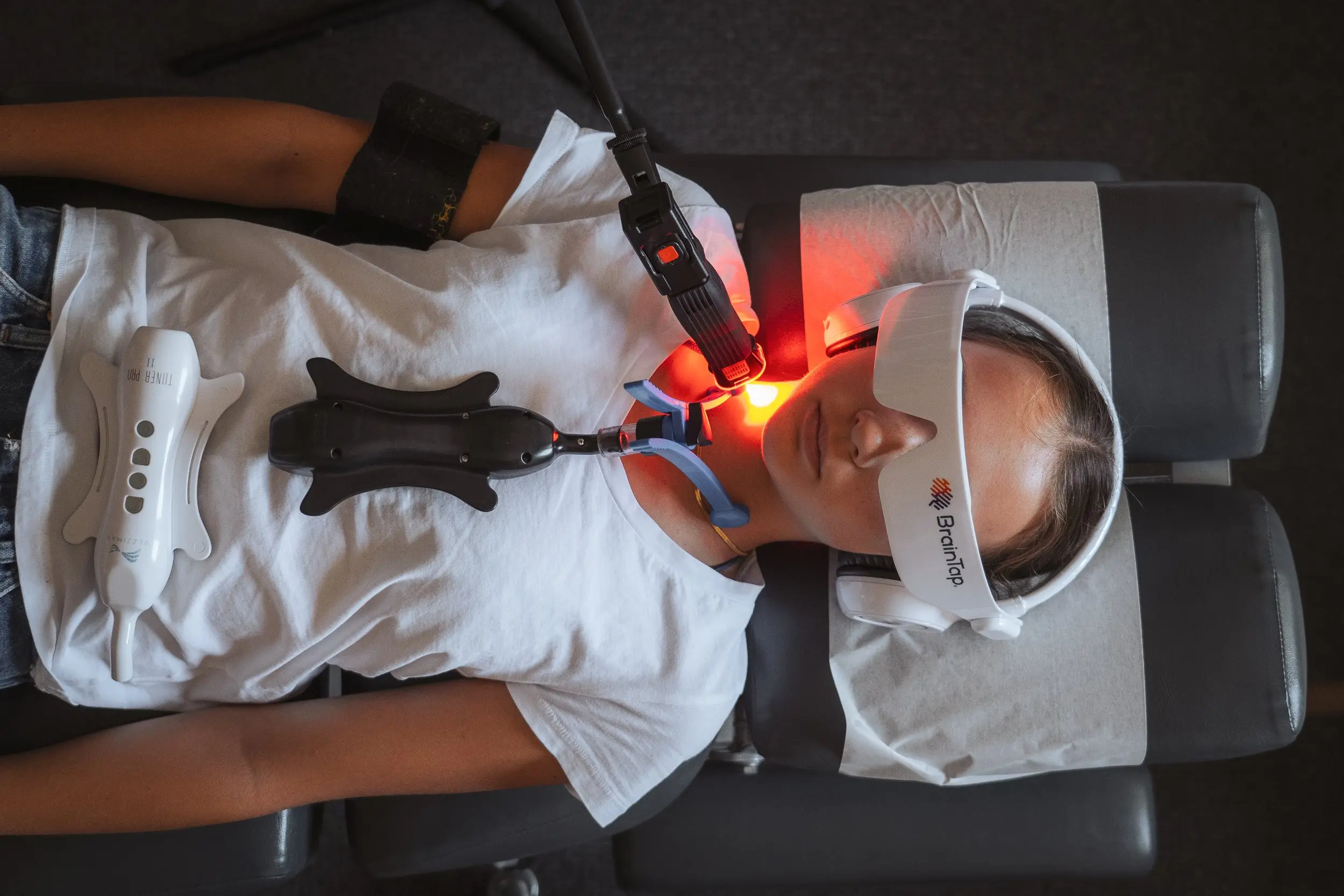
Brainshape's programs use a combination of technologies and sensory inputs designed to stimulate the nervous system in different ways.
These can include infrared and red-light lasers, vibration, electrical stimulation and Stimpod technology, which is used to stimulate the vagal nerve.
The goal is not simply to make a child sit still or behave differently.
It is regulation.
"Most kids really love it," says Dr Zoe. "There are balance exercises, gaming, all sorts of things, but it's multilevel stimulation. Our goal is always regulation."
For a child who is constantly operating in a heightened fight-or-flight state, learning and development can become much harder.
So before asking a child to concentrate, learn, coordinate or regulate their emotions, Brainshape looks at whether the underlying system is ready to do so.
Families may initially undertake a more intensive program, often attending two or three times a week.
Dr Zoe says parents and teachers can sometimes notice changes relatively quickly, before treatment transitions into a less intensive program that can continue for up to 12 months.
The journey is different for every child because every developing brain is different.
And that is ultimately the philosophy behind Brainshape: rather than simply managing the behaviour that is visible on the outside, look deeper at the developmental foundations underneath it.
.webp)
For parents, the hardest part can sometimes be knowing whether what they are seeing is simply a stage, or whether there is something worth investigating.
You don't need to wait until a problem becomes overwhelming to start asking questions.
"The fate of the adult brain lies in the child's development," says Dr Zoe. "If we can check early and make sure the child is developing the way they're meant to, we can make a real difference."
Early understanding can create the opportunity for earlier support.
And sometimes, the first step isn't a diagnosis.
It's simply understanding more about how your child's brain is developing.
Could you recognise the signs?
Take the Brainshape Test to gain a better understanding of your child's developmental profile and discover whether there may be areas worth exploring further.
Ready to find out more?
The ad that brought you here was designed to connect you with a local business we’re proud to work with. Head to their site to find out more.
Visit Now ›You’ll be leaving beachescovered.com.au and visiting our client’s website.


